Carbon Dioxide Absorbent is used to remove carbon dioxide from enclosed air, industrial gases, and process streams. Its applications range from anesthesia machines and diving rebreathers to submarines, spacecraft, biogas upgrading, and post-combustion carbon capture. In a rebreather, a canister may contain soda lime, where calcium hydroxide reacts with exhaled carbon dioxide. The outlet gas must remain breathable. Small errors matter.
Industrial systems often use aqueous amines, potassium carbonate, or solid sorbents. These materials separate carbon dioxide from flue gas before emissions reach the atmosphere. The captured gas can support storage, enhanced chemical production, or other controlled uses. However, absorbent selection depends on temperature, humidity, impurities, pressure, and regeneration energy.
The International Energy Agency identifies carbon capture as important for reducing emissions from cement, steel, and difficult industrial sectors. The Global CCS Institute’s 2024 Global Status of CCS report recorded more than 50 operating commercial capture facilities worldwide, with many additional projects under development. These figures show momentum, not guaranteed success.
Gary T. Rochelle, a leading carbon-capture researcher, wrote that “the energy requirement for solvent regeneration is the largest barrier to widespread application of amine scrubbing” in Science. That warning remains practical. An absorbent can capture carbon dioxide effectively, yet consume excessive heat during reuse. The picture is promising, but incomplete. Real performance depends on measured capacity, degradation, corrosion, safety, and operating cost. This article examines what Carbon Dioxide Absorbent is used for, where it performs well, and where its limitations deserve closer attention.
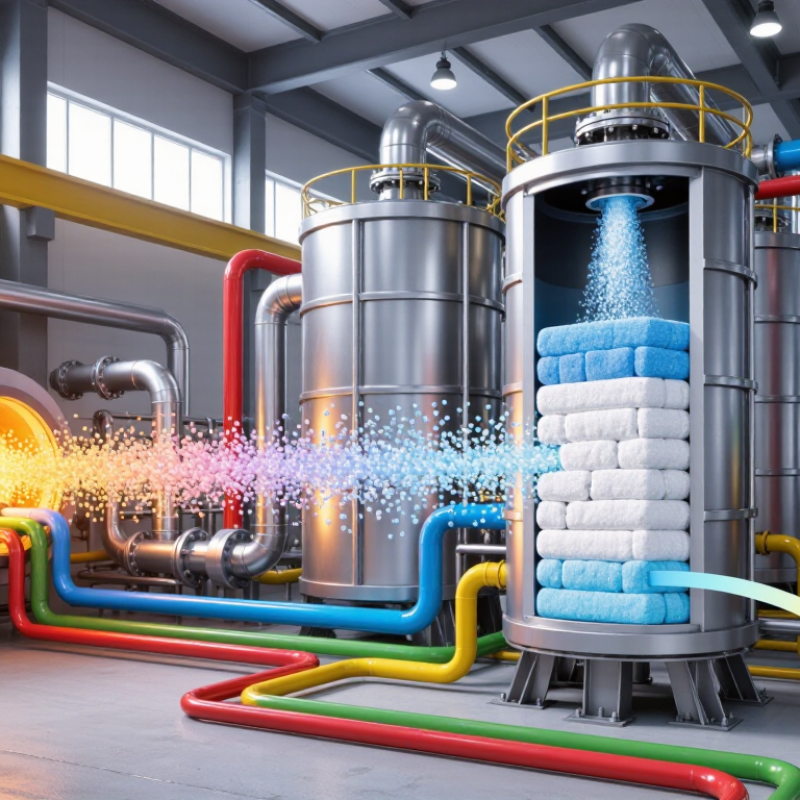
A carbon dioxide absorbent is a solid material that removes CO2 from air or exhaled gas. It is commonly used in anesthesia breathing systems, respiratory equipment, and closed environmental-control systems. Most medical absorbents contain porous soda lime granules, mainly calcium hydroxide. Small amounts of sodium or potassium hydroxide help accelerate the reaction. When exhaled CO2 passes through the canister, it reacts with the granules and forms carbonates, water, and heat.
The granules matter. Their size affects airflow, contact time, and resistance. A pale indicator may also change color after absorption capacity declines. However, color alone is not a perfect safety signal. Moisture, gas flow, temperature, and storage conditions can influence performance. The NIOSH Pocket Guide lists 5,000 parts per million as an eight-hour recommended exposure limit for CO2, with 30,000 parts per million as a short-term limit. OSHA reports the same 5,000 ppm eight-hour permissible exposure limit. These figures describe workplace exposure, not absorber capacity. That distinction is important. A canister may appear normal while its usable capacity has already fallen. In practice, trained operators should follow validated replacement schedules, monitor equipment readings, and inspect granule condition. Carbon dioxide absorbent sounds simple. It is not.
| Absorbent Type | Main Active Material | How It Removes CO₂ | Typical Applications | Regeneration or Disposal | Key Considerations |
|---|---|---|---|---|---|
| Alkaline hydroxide absorbent | Calcium hydroxide, often with small amounts of sodium or potassium hydroxide | Reacts chemically with carbon dioxide to form carbonate compounds and water. | Closed-circuit breathing systems, anesthesia equipment, laboratory gas treatment, and confined-space applications. | Generally used once and replaced because the chemical reaction is not practically reversed under normal operating conditions. | High CO₂ removal efficiency; moisture is usually required for effective operation. Dust, heat generation, and caustic exposure must be controlled. |
| Soda lime | Primarily calcium hydroxide, with sodium hydroxide or potassium hydroxide and water | CO₂ is converted into carbonate through a series of hydroxide reactions. | Medical breathing circuits, diving rebreathers, respiratory research, and sealed laboratory systems. | Normally discarded after its usable capacity is reached. | Useful in low-flow or closed-loop systems. Performance depends on airflow, granule size, moisture, temperature, and contact time. |
| Lithium hydroxide absorbent | Lithium hydroxide | Combines with CO₂ to produce lithium carbonate and water. | Spacecraft and spacecraft-like life-support systems, portable breathing equipment, and specialized emergency systems. | Usually non-regenerable in the equipment and replaced after saturation. | Low molecular mass provides high CO₂ capacity by mass, but the material is relatively costly and requires careful handling. |
| Amine-based liquid solvent | Aqueous solutions of amines, such as primary, secondary, or sterically hindered amines | Reversibly reacts with CO₂ to form carbamate and bicarbonate species. | Post-combustion carbon capture, natural-gas sweetening, hydrogen production, and industrial gas purification. | Regenerated by heating the rich solvent in a stripper; the released CO₂ can then be compressed or processed. | Suitable for continuous industrial operation. Energy use for regeneration, solvent degradation, corrosion, and emissions require management. |
| Physical solvent | Organic liquids that dissolve CO₂ without forming a strong chemical bond | CO₂ dissolves in the solvent under elevated pressure and is released when pressure is reduced or mild heat is applied. | High-pressure synthesis gas treatment, hydrogen processing, ammonia production, and natural-gas purification. | Regenerated mainly by pressure reduction, with limited heat demand compared with many chemical solvents. | Most effective at higher CO₂ partial pressures; performance decreases when the gas is dilute or near atmospheric pressure. |
| Solid amine sorbent | Amine groups supported on porous silica, activated carbon, polymers, or other porous solids | CO₂ binds chemically to amine sites on the solid surface. | Direct air capture research, low-concentration gas treatment, indoor-air systems, and modular carbon-capture units. | Regenerated using heat, vacuum, moisture changes, or a combination of these methods, depending on the material. | Can work at low CO₂ concentrations. Capacity, humidity tolerance, cycle life, and regeneration energy are important design factors. |
| Zeolite molecular sieve | Crystalline aluminosilicate with uniform micropores | Adsorbs CO₂ physically through selective interactions within its pores. | Compressed-air purification, biogas upgrading, natural-gas processing, and separation of CO₂ from other gases. | Regenerated by pressure-swing adsorption, temperature-swing adsorption, or a combination of both. | High selectivity can be achieved, but water vapor competes strongly for adsorption sites in many zeolite structures. |
| Activated carbon | High-surface-area porous carbon | Retains CO₂ through physical adsorption on internal surfaces; performance can be improved by chemical modification. | Gas purification, odor-control systems, research devices, and selected pressure-swing adsorption processes. | May be regenerated by pressure reduction, heating, or vacuum, depending on the design and contaminant load. | Relatively versatile, but CO₂ capacity is strongly affected by temperature, pressure, pore structure, humidity, and surface chemistry. |
| Metal-organic framework sorbent | Porous crystalline networks made from metal nodes and organic linkers | Adsorbs CO₂ in precisely engineered pores through physical interactions or specific binding sites. | Advanced gas separation, carbon-capture research, biogas purification, and selective gas-storage studies. | Usually regenerated by pressure or temperature changes; the method depends on the framework structure. | Very high tunability and surface area are possible, while cost, moisture stability, manufacturing scale, and long-term durability remain important considerations. |
| Membrane contactor absorbent system | A liquid absorbent, commonly an aqueous amine or alkaline solution, combined with a gas-selective membrane | The membrane provides a large gas–liquid contact area while the liquid chemically or physically captures CO₂. | Compact industrial gas treatment, biogas upgrading, and research-scale carbon-capture equipment. | The liquid absorbent is regenerated in a separate process and can be circulated through the system. | Compact equipment and high contact area are advantages; membrane wetting, solvent compatibility, pressure balance, and fouling must be controlled. |
It is a solid material that removes carbon dioxide from air or exhaled gas. Common uses include breathing circuits, respiratory equipment, and closed environments. The material reacts with CO2.
Alkaline compounds react with carbon dioxide when gas contacts their active surfaces. Calcium hydroxide can form carbonates, water, and heat. The reaction is not perfectly clean.
Soda lime mainly contains porous calcium hydroxide granules. Small amounts of alkaline hydroxides may accelerate the reaction. Granule size affects airflow and contact time.
Yes. Porous solids hold CO2 on internal surfaces. Pressure reduction or heating can release the captured gas. Moisture may occupy adsorption sites.
Common options include amines, zeolites, activated carbon, metal-organic frameworks, and calcium oxide. Each material suits different temperatures, gas mixtures, and moisture levels. No material wins everywhere.
Moderate moisture may improve some chemical reactions. Excess water can block pores or damage the sorbent. Temperature also changes capacity, reaction speed, and regeneration energy.
A color indicator may fade or change after capacity declines. Color alone is not a reliable safety signal. Check readings, granules, storage history, and replacement guidance.
Rising CO2 readings, unusual heat, dust, channeling, or abnormal airflow may indicate reduced performance. Use a sensor when possible. Guesswork feels easy, but it can fail.
No. Plant conditions can reduce capacity through humidity, impurities, cycling, and incomplete regeneration. Test the material under realistic site conditions. The neat result may not survive.
A Carbon Dioxide Absorbent is a material designed to remove carbon dioxide from air or other gas mixtures through chemical or physical reactions. It helps maintain breathable air, protect sensitive equipment, and control gas composition in enclosed or industrial environments. During absorption, carbon dioxide molecules are captured by reactive compounds or held within porous materials. The efficiency of this process depends on factors such as temperature, humidity, airflow, exposure time, and the absorbent’s capacity.
Carbon dioxide absorbents are used in breathing systems, enclosed storage spaces, laboratories, medical environments, and various industrial processes. Common absorbent materials include alkaline compounds, porous solids, mineral-based substances, and specially engineered chemical mixtures. They should be stored in sealed containers, kept away from excessive moisture and heat, and handled according to safety instructions. Once the material becomes saturated or its performance declines, it should be replaced properly to ensure reliable carbon dioxide control and safe operation.

 JIMPOCHEM